
My Oscars Death Race
Discovering the National Treasure of Kokuho

A Burgeoning Cinephile
I’ve always kind of been a cinephile but I just didn’t know it right away. I would get laughed at by my friends in high school because I didn’t immediately get up when the credits rolled. I’d want to stay there and just absorb the film, decompress and think about what I watched, and let the music slowly keep the vibe going.
Then I remember finding Roger Ebert’s website during downtime on my telephony job in college. I loved his philosophy on film, which was about measuring it against its intended audience. He was mostly positive with movies and saw them as “machines that generate empathy.” I would read all of his reviews and started to seek out and discover great films, new and old, based on his writing.
Over the years I embraced the medium more and more, recognizing that it spoke in a language that I loved to learn. It could communicate through sounds and images and stories in a way that seemed to hit directly into things I understood but couldn’t communicate in any other way. I got interested in a wider range of art and found I was as enthralled with a 1929 silent Soviet documentary like The Man with the Movie Camera—an experiment in pure visual play, as I was with a zany Charlie Kaufman picture like Being John Malkovich.
r/OscarsDeathRace
For a new cinema lover working through lists of the best films, the Oscars is an undeniable place to start. While any award for art is by nature subjective, it gives a point from which to learn about what our culture and the industry itself think are the great works. Over the years I started to pay more attention to each year’s list of new films and digging into past winners and nominees.
A few years ago someone on a Facebook film group posted a ballot for that year’s upcoming Oscars and said they had completed their goal of watching everything that was nominated in every category. This had never occurred to me but made complete sense and lit something in me. I’m a completionist and love to find undiscovered gems, even if it means at times slogging through some well-regarded titles that just don’t land for me.
So it has been a half-committed goal since then to see as many Oscar nominees as I can. Each year I start a list and go checking off what I can get through. I’ll search online to find out showtimes and streaming release dates. Sometimes it can be quite hard to find a legitimate way to watch a film that was only released in New York and LA for a week in December and hasn’t been given a wide release or gotten a distribution deal online with one of the platforms.
This year, in the midst of that search, I the subreddit r/oscarsdeathrace. Its subscribers were dedicated to seeing every nominated film, too, shorts and all. They share links and encouragement and their favorite watches. These were my people. And although my wife raises her eyebrows at their community name, I find it quite apt. Here are others willing to spend extra time and money to reach a slightly ridiculous goal.
Finding them helped me get serious and fully commit to my goal. This is my year.
The Commitment
The thing is, anytime you set a goal there are challenges, and soon I had to really decide if I was going to commit. It has been, overall, a fairly easy year as a deathracer (my term, not theirs). Before nominations are announced I’d already done a good job of seeing the obvious contenders like Marty Supreme and One Battle After Another, which I knew I would likely enjoy. There were others like Sinners and Frankenstein that I had mild interest in but wouldn’t have prioritized if it weren’t for the nomination. There were also films like Richard Linklater’s Nouvelle Vague, about the beginning of the French New Wave of cinema, which I loved, though it didn’t end up being nominated.
But there are always some documentaries or nominees in categories like Best Song or Makeup and Hairstyling that, while interesting, might not seem as essential. If they are harder to find, aren’t nominated in any other categories, and don’t have any other points of interest, I might miss them. Like Mrs. Harris Goes to Paris which was nominated for Costume Design a few years ago. It looked like a fun movie! But I didn’t fit in the time to see it.
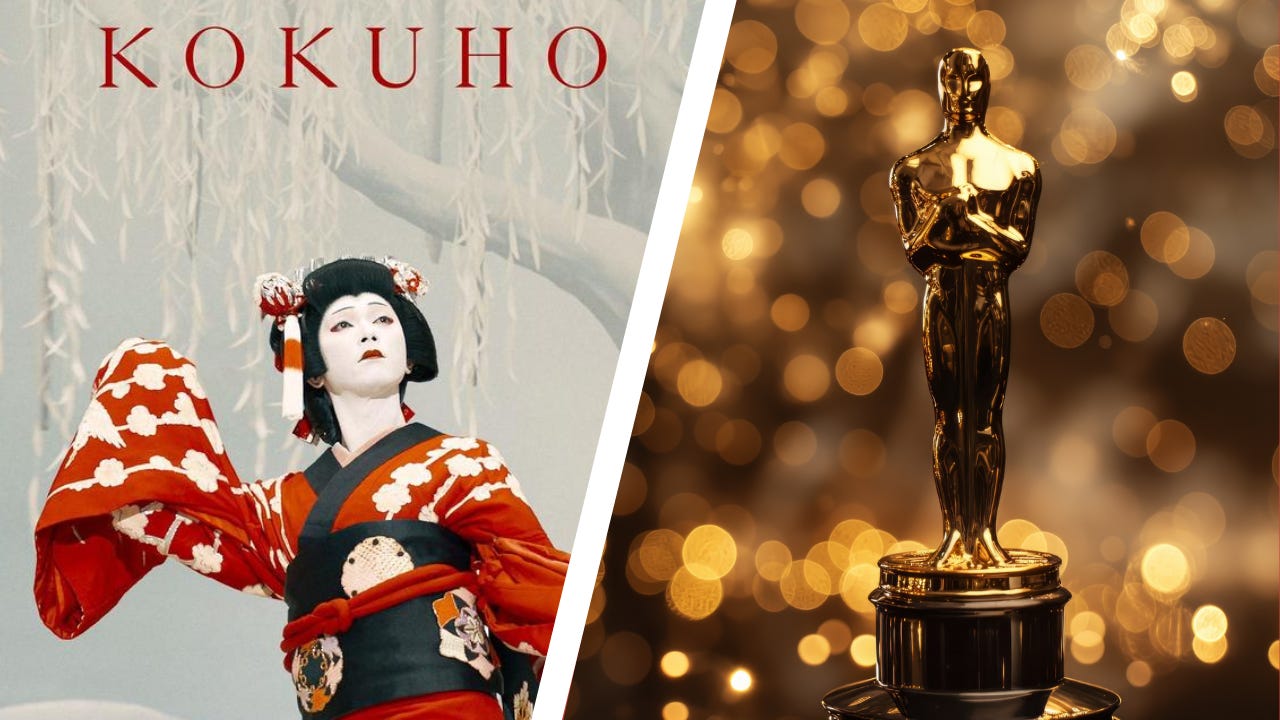
This year, the point at which I had to really decide if I was going to do it was last week. It looked like the hardest film to see would be Kokuho, a 3-hour Japanese film following characters in the world of Kabuki theater. It was nominated for Makeup and Hairstyling. It is still in its theatrical run so the only way to see it was an 8:45 pm showing 30 minutes away. That meant I wouldn’t be getting home until 12:30 am. Not unheard of for me, but was I going to make it through 3 hours of a film I knew nothing about?
But I made the commitment and bought the ticket 2 days in advance to hold myself to it. As others on the subreddit would attest, it’s called a death race for a reason. You have to make sacrifices.
I was so glad I did. The first good sign was seeing Japanese people walking into the theater as I arrived. If they were clued in enough to come see their national export I felt that was a good omen. I bought my popcorn and soda—buying a medium rather than my usual small, opting to forego saving calories in support of keeping me awake. It was a different multiplex from my usual so I was pleased at the high quality automatic reclining feature and—wonder of wonders—heated seats.
The Treasure of Kokuho
Then I went on to enjoy what became one of my favorite films of the year. Kokuho is a sumptuous, epic story following two friends—adopted brothers, really—over several decades in the world of kabuki theater in Japan. It follows Kikuo Tachibana, who at the beginning of the film is introduced as the teenage son to a yakuza lord. It is a night of celebration, Nagasaki 1964. Kikuo is performing some amateur kabuki for the guests. He is a male performing as a female, called onnagata, which an opening card tells us is a longstanding tradition coming from a more conservative era. A visiting kabuki master is taken by his performance. The colors are rich and the picture is textured with the beautiful imagery of the party guests in formal attire in a luxurious tea house.
We then see Kikuo afterwards with his castmate reveling in the high of a successful performance. A commotion is heard in the dining room. A rival gang is attacking and people are running. Kikuo is taken by the master as he yells after his father, who he sees in full battle mode. He bravely faces his attackers, nodding to his son, before falling before so many foes.
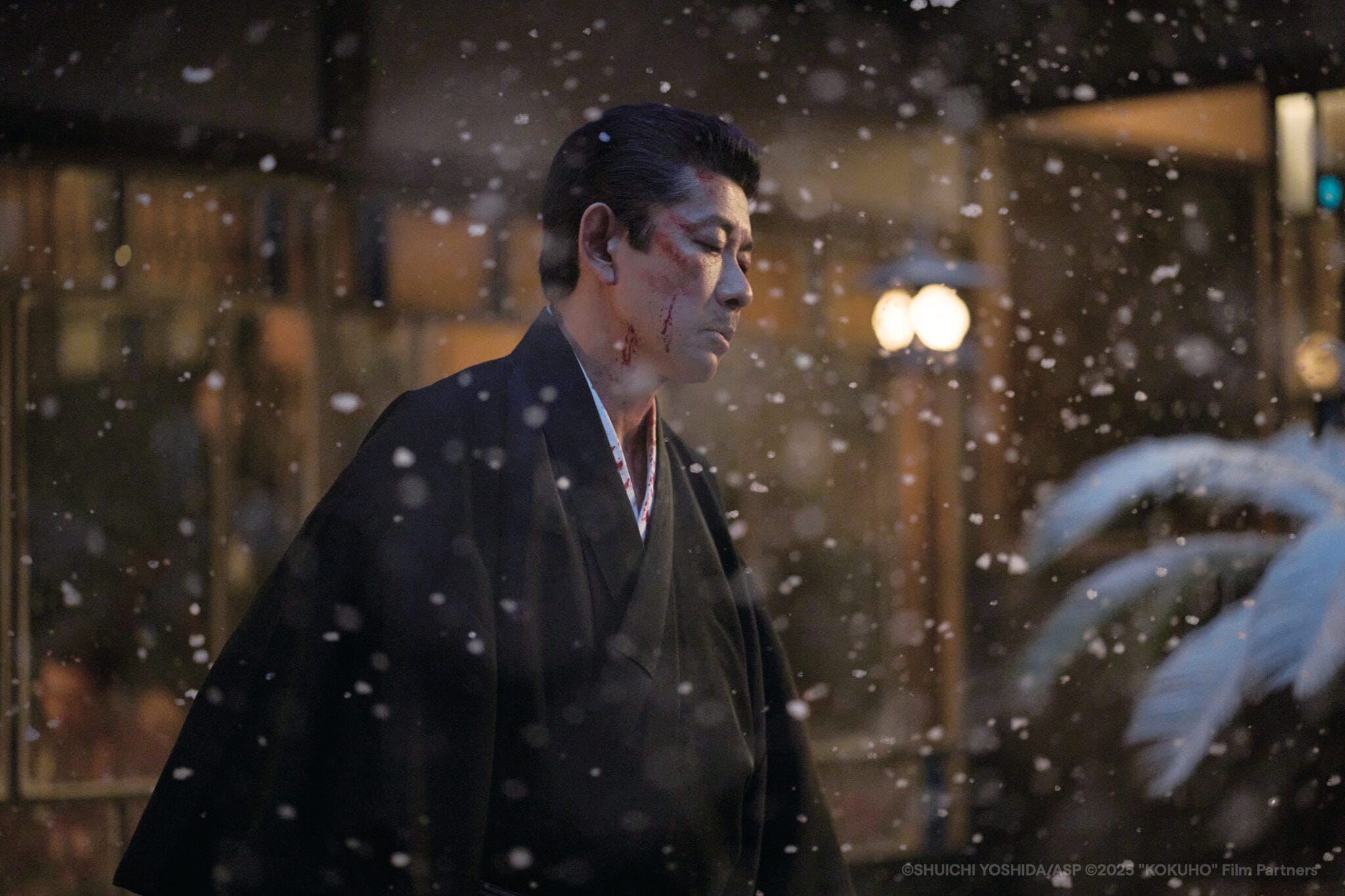
This breathtaking opening sequence sets the stage for an elegant and meticulously portrayed story. In terms of references, as the story of the friends and their career in kabuki develops over the years, I kept thinking this is like a better version of Once Upon A Time in America. It had so many of the same beats, but done more effectively. The journey of these two characters through their love of performing, family dynasties, deaths, pride, and forgiveness, covers a lifetime. The emotional story was real and cathartic. The entire production was lovingly made and the experience magical. The closing song was a perfect fit.
The Joy of Discovery
Among the many great joys of the film are the extended kabuki play performances. These are traditional stories that have been told for generations. As each one begins it is framed with the title in beautiful Japanese characters. Knowing what the film was nominated for, I also paid special attention to the makeup and hairstyling. As onnagata, the characters spend a lot of time putting on and removing makeup, hair, and costume, also part of a long and rich tradition. A close-up of a fine brush carefully applying white face paint quickly becomes iconic in the film.
I was curious on the meaning of the name, Kokuho, and learned it translates as “national treasure.” The name is a great fit, paying respect to a practice of Japanese pride, while also referring to Kikuo himself, who becomes one of the great onnagata, despite the costs. The entire film is a love letter to the art form and its producers, and, through the specificity of that world, to film and art itself. The lead makeup artist, and now first-time Academy Award nominee, Naomi Hibino, spent her entire career in the kabuki world. This is her first film. She said:
“After a while,…as I recognized that our work really had been nominated, I still felt that it was not really for me…This recognition was for a traditional performing art form that has continued for several hundred years in my country — it was recognition for the countless people who have inherited and nurtured our art, including my sensei, who taught me everything to get here.” (Hollywood Reporter)
The makeup is truly central to the story of Kokuho. There are things between our two protagonists that can only truly be communicated while playing different characters on stage and in full regalia. They have these personas they wear in their lives. With the themes of inheritance, adopted family, and external vs internal identity, there is much to explore with how we choose to present ourselves to the world. The act of applying their makeup is a consistent ritual throughout the film, yet represents something different as the characters change.
The Oscars Death Race is about finding and discovering new things to love as much as it is about bragging rights. Great movies require a team of experts and artists across every aspect of filmmaking to portray characters and story on the screen. My slightly absurd commitment gave me this moving experience and helped me appreciate the Makeup and Hairstyling category and the people behind it, along with the cultural phenomenon of kabuki. It pushed me to explore something I would not have sought out myself.
And you know I sat through the entire credits.